Exhibitions have always been about making an impactful impression. The challenge today is making that impression without creating unnecessary waste, excessive transport emissions, or a stand that ends up in a skip after a few days on the show floor.
At Imageco, we’ve spent more than 25 years developing sustainable exhibition solutions. Our in-house team spans a range of print services, all working together under one roof in Leeds.
What we’ve learned over that time is straightforward: when cardboard is engineered correctly, it can deliver strength and creativity whilst supporting more responsible event practices.
A typical exhibition stand has a complex journey. Components are manufactured, graphics are produced, the stand is transported to a venue. It is then assembled, dismantled, and either stored, reused, recycled, or discarded.
Every stage has an environmental impact. For exhibitors, that means material selection is becoming an increasingly important part of stand design, and today cardboard offers an alternative approach.
Because cardboard products are lightweight, and manufactured using renewable paper fibres, they help reduce the environmental impact associated with many exhibition builds.
At Imageco, sustainability runs through everything we do. Our commitment to sustainability is reflected in our business. From our ISO 14001 certified environmental management system to our 90 solar panels generating clean energy on site. Every part of our operation is built around reducing impact.
The word “cardboard” can be misleading.
Materials such as Xanita board are engineered specifically for structural applications. Its repulpable core creates impressive rigidity whilst keeping weight to a minimum, and because it’s manufactured from fibres recovered from recycled cardboard boxes, its sustainability credentials start long before it arrives in our workshop.
Being a lighter material, it can also simplify build times and make it easier to move displays between venues. For businesses attending multiple exhibitions throughout the year, those efficiencies add up quickly.
When it comes to printing on Xanita board, the quality of the finish matters just as much as the engineering behind the structure. Our swissQprint Nyala 4 and HP Latex 830W printers are among the most advanced wide-format systems available, delivering exceptional colour accuracy and consistency at scale.
The HP Latex 830W uses water-based inks with no hazardous air pollutants, adding another layer of environmental credibility to the finished stand. It’s also the print industry’s only EPEAT(R) Climate+ registered printer, which is the premier global ecolabel for electronics and technology products. The HP Latex 830 W meet rigorous criteria based on the full lifecycle, and has been independently verified against their criteria.
The result is a cardboard exhibition stand that delivers both operational and environmental benefits, making it an increasingly attractive option for brands looking to exhibit more sustainably.
One of the biggest misconceptions about sustainable exhibition design is that it somehow restricts creative possibilities.
Cardboard can be transformed into complex structures, feature displays, branded environments, and fully bespoke exhibition experiences through digital design, CAD engineering, and CNC cutting.
This includes Imageco’s original innovation, the ExhiBox, a reusable cardboard exhibition stand. A precision-engineered, modular exhibition stand that is fully recyclable and can be made completely bespoke. Its modular nature means it easily transforms into layouts of any size. Whether you need a 4x4m cardboard exhibition stand layout, a 3×3, or even a 6×3, the ExhiBox flexes to your needs.
Our CAD engineers are central to this process. Digital prototypes are developed and refined before a single sheet of board is cut, allowing the team to test concepts, optimise material usage, and reduce waste throughout the project lifecycle.
For clients who want full visibility on their environmental impact, we also provide project-specific Carbon Metric Reports. These cover materials, production, and transport, giving exhibitors the data to present to stakeholders, influence event strategies, and inform future decisions.
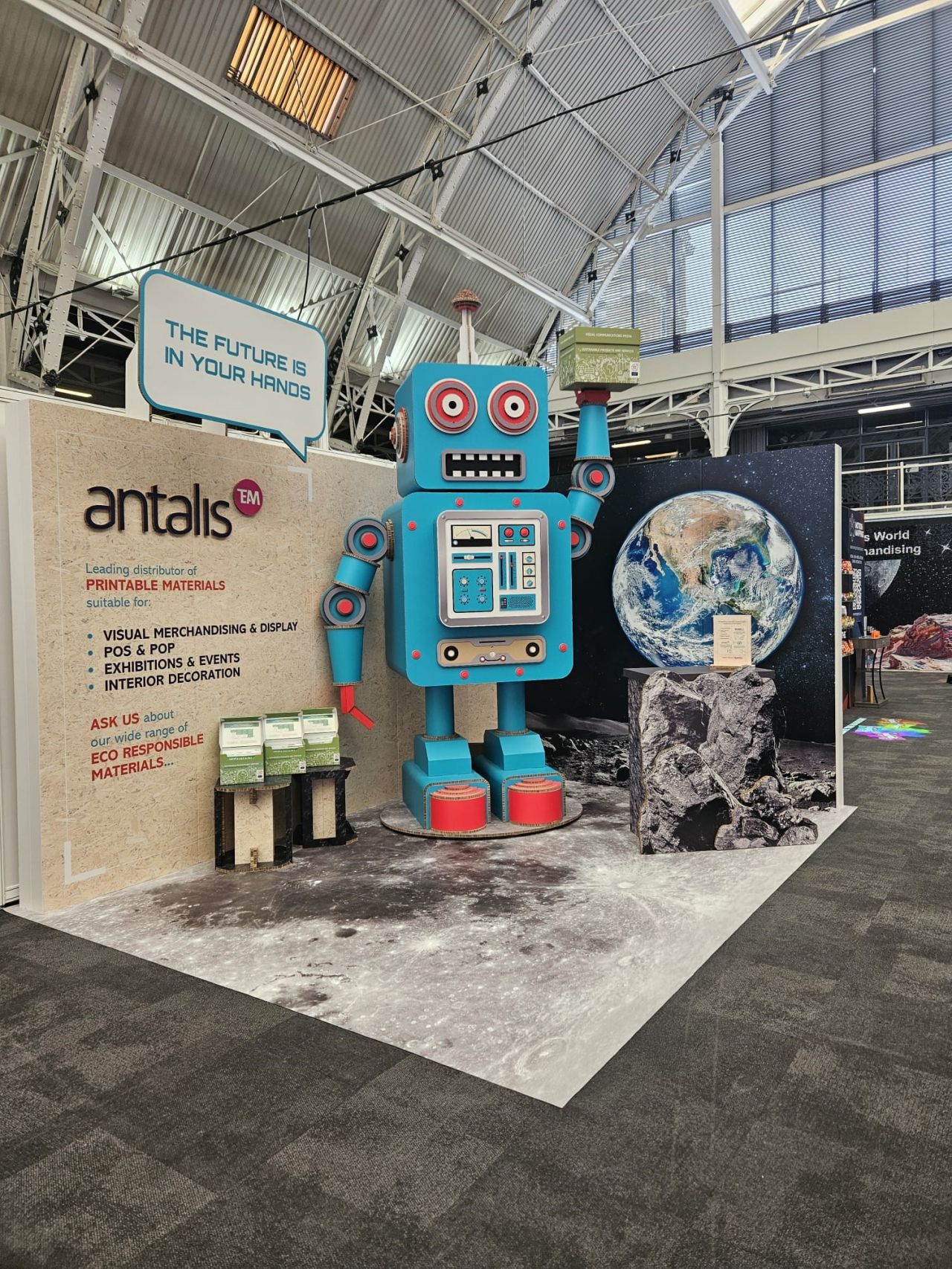
A great example of our cardboard engineering in action is Cardbot, a project we created for Antalis at the VM & Display Show.
The brief challenged us to showcase the capabilities of Xanita board in a way that would capture attention and spark conversation. The result was a 3.5-metre-tall robotic structure built entirely from cardboard, alongside a complete 4m x 3m exhibition stand using the same material. Every element was carefully designed to demonstrate the structural strength and visual quality that cardboard engineering can achieve.
The project’s total footprint was measured at just 130kg CO₂e. Calculations showed that the carbon impact would have been at least three times higher had the stand been manufactured using traditional materials.
Cardbot demonstrated exactly what sustainable exhibition design should achieve. A memorable visitor experience, innovative materials on show, and a significantly reduced environmental footprint, all without compromising on creativity or impact.
A cardboard exhibition stand is far more than a sustainable substitute for traditional materials. It is a smart design solution that combines creativity, structural performance, and environmental responsibility, and it starts long before the board is cut.
At Imageco, we bring over 25 years of experience in print, display, and exhibition production together with an in-house team of designers, CAD engineers, and cardboard engineers, all supported by some of the most capable wide-format printing technology in the industry.
Whether you’re planning a clean, simple exhibition space or a large-scale experiential installation, we can help you explore how sustainable materials can deliver maximum impact with a lighter footprint. Reach out to our team and discuss your next sustainable stand!